Skip to content
Rochester Foundation Repair Co

Serving Rochester and nearby areas

Stair-Step Cracks in Block and Brick in Rochester, NY

Stair-step cracks in a Rochester block wall or brick face mean part of the wall has moved, and a free inspection tells you whether it is old and settled or still on the move.

Book a free foundation inspection

Tell us what you are seeing. A local specialist calls you back the same business day.

Local to Rochester

We connect property owners in Rochester and nearby areas, including Corn Hill, South Wedge, Park Avenue, 19th Ward, Greece and Irondequoit, with one independent local foundation repair specialist.

  • Ground that changes fast

    Cobbs Hill in Rochester is a moraine of boulders, sand and gravel left by the melting ice sheet. On ground like this, soil can change from one end of a house to the other.

  • An old beach under Ridge Road

    Ridge Road through Greece, Irondequoit and Webster sits on sand and gravel from the shore of glacial Lake Iroquois. A house can sit on beach sand at one corner and denser soil at the other.

  • Frost about 42 inches down

    The Town of Chili sets deck posts at least 42 inches deep. Footings that are shallow, or soil that stays wet near one corner, give frost a chance to lift and drop part of a wall.

What it costs

Typical published ranges for Rochester. The contractor's written estimate is the price, and the inspection is free.

WorkTypical range
Inspection and written estimate Free
Seal a leaking crack $200 to $1,000
Repoint brick joints $3 to $15per sq ft
Steel or helical pier at a sinking corner $1,000 to $3,000per pier
Gutters and downspout extensions $3 to $30per linear foot

See typical foundation repair prices in Rochester

What a stair-step crack looks like

A stair-step crack follows the mortar joints in a block or brick wall. It goes over one block, down one row, over one block, down one row. It looks like a set of steps.

You may see it in a few places.

In a block basement wall

Often near a corner, running up from the floor or down from the top.

On outside brick

Often from the corner of a window or door, or near the end of the house.

On a chimney

Brick chimneys crack this way when they lean or sink.

At the ends of a long sideways crack

This often means the wall is bowing in.

Pay attention to the shape. Is the crack the same width all the way, or wider at one end? Do the blocks on each side still line up? Is there a gap you can fit a coin into?

Why they happen in Rochester

Mortar joints are the weak part of a block or brick wall. When the wall moves, the joints give first. The question is what moved it.

One corner settles. The glacier left the Rochester area with mixed ground. Drumlins of packed till sit next to old lake beds. Ridge Road runs on beach sand and gravel from glacial Lake Iroquois. If one corner of a house sits on softer soil, it can sink a little more than the rest.

Water at one corner. A downspout that dumps at a corner soaks the soil there. Wet soil is softer and heavier. It can let a footing sink or push the wall in.

Frost. Frost can reach about 42 inches deep here. Shallow footings on porches, additions and garages can lift in winter and drop in spring. That up and down can crack the wall where it joins the house.

A bowing wall. When a block wall bows in, it often cracks sideways in the middle and in stair steps near the corners.

Age. Many homes in the suburbs were built in the 1950s and 1960s on block. In one Census profile of Greece, more than half of the homes date from those two decades. Seventy years of seasons can open old joints.

When it is minor and when it is urgent

Worth watching:

  • A thin crack, the same width end to end.
  • A crack that has not changed in a year of checks.
  • No water and no sticking doors.

Call soon:

  • A crack wider than a coin.
  • A crack that is wider at one end.
  • Blocks or bricks on one side that stick out past the other side.
  • Water coming through the crack.
  • Doors or windows near that corner that stick.

Call right away:

  • A crack that grew a lot in one season.
  • A wall that bulges in near the crack.
  • A chimney pulling away from the house.

How stair-step cracks usually get fixed

The fix depends on what moved the wall.

Water control

Extend downspouts and regrade so water stays away from the corner. This is often step one.

Repoint or seal

Once the wall is stable, the joints are cleaned and filled. Leaks are sealed.

Piers

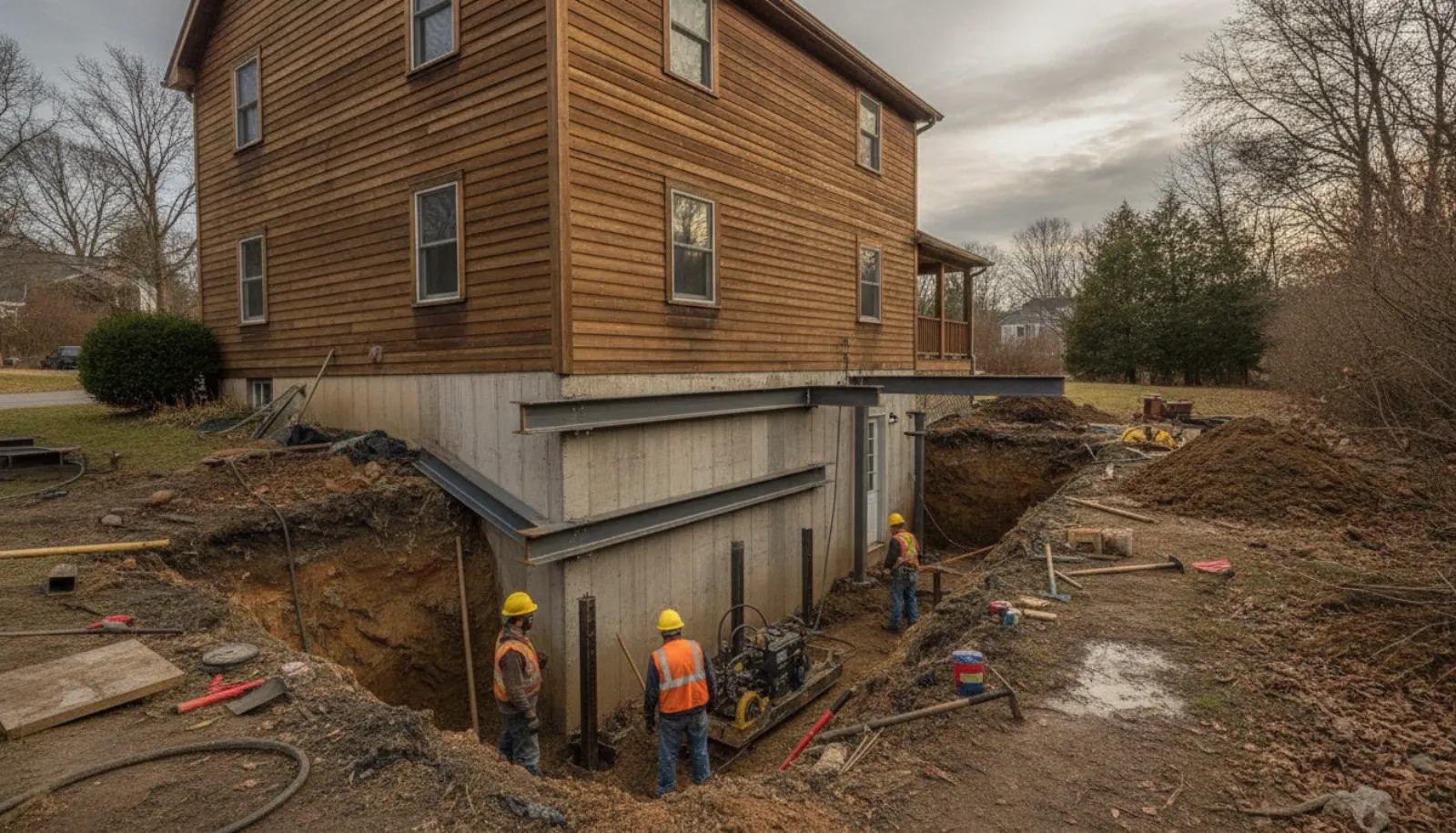
If a corner is sinking, steel or helical piers go down to firmer soil and hold that part of the house. Some can lift it back up a little.

Wall bracing

If the cracks come from a bowing wall, the wall is braced with anchors, beams or straps.

Rebuild a section

Badly shifted block or brick may need to be taken out and relaid.

What it typically costs

These are typical national ranges from published cost guides, not a quote. Many stair-step cracks need only water control and joint repair. Pier jobs need several piers, so the total is higher. The cost guide has more.

What to do before the inspection

  1. Mark the ends. Draw a pencil line at each end of the crack and write the date.
  2. Measure the width. Measure at the widest and narrowest spots.
  3. Take photos. Put a ruler or coin in the picture. Shoot inside and outside if the crack shows on both.
  4. Look for a match. Check if the same corner has a crack upstairs or a sticking door.
  5. Find the downspout. Note where the nearest one dumps its water.

Frequently asked questions

Are stair-step cracks always serious?

No. A thin stair-step crack that has not changed in years may be old settling that has stopped. A crack that is getting wider, is wider at one end, or shows up with sticking doors is still moving and needs a look.

Can I just fill the crack with mortar?

You can, and it keeps water out. But if the wall is still moving, the crack will open again, often right next to the patch. Find out why it cracked first.

What does it mean if the crack is wider at the top?

A crack that is wider at the top often means the corner below it is dropping, or the top of the wall is being pushed. A crack that is wider at the bottom can mean the middle of the wall is sinking or the corner is lifting.

Do stair-step cracks in brick mean the foundation is failing?

Not always. Brick can crack from settling, frost, rusted steel over windows, or a foundation that moved. The inspector checks the foundation under that spot to see if the two line up.

Will a buyer's inspector flag a stair-step crack?

Usually yes. Cracks in block or brick are easy to spot. Having it checked, and fixed if needed, with paperwork, makes the sale go smoother.

Found a stair-step crack?

Call (585) 449-9661 or send the short form with a photo. A local crew will call back to set up a free inspection and a written price.

(585) 449-9661 Free inspection