Skip to content
Rochester Foundation Repair Co

Serving Rochester and nearby areas

Sloping and Sagging Floors in Rochester, NY

Sloping floors in an older Rochester home usually come from a tired beam, post or sill in the basement, and a free inspection finds which one before the floor gets worse.

Book a free foundation inspection

Tell us what you are seeing. A local specialist calls you back the same business day.

Local to Rochester

We connect property owners in Rochester and nearby areas, including Corn Hill, South Wedge, Park Avenue, 19th Ward, Greece and Irondequoit, with one independent local foundation repair specialist.

  • Old houses, old framing

    More than half of the homes in the City of Rochester were built in 1939 or earlier. Wood beams and posts that old have carried the house for 85 years or more.

  • Damp basements are hard on wood

    The National Weather Service says soils around Rochester are wet in spring. A basement that stays damp can rot the wood sill on top of the wall and the bottoms of wood posts.

  • The 19th Ward and similar blocks

    About 7 in 10 homes in the 19th Ward date from 1939 or earlier. Neighborhoods like this see a lot of sagging center beams and old posts.

What it costs

Typical published ranges for Rochester. The contractor's written estimate is the price, and the inspection is free.

WorkTypical range
Inspection and written estimate Free
Replace or add a floor joist $100 to $300per joist
Sagging floor repair, typical job $1,000 to $5,000
Replace a beam $1,500 to $5,000per beam
Steel pier under a sinking wall $1,000 to $3,000per pier

See typical foundation repair prices in Rochester

What sloping floors look like

You may notice it before you can see it.

A ball or marble rolls

It heads to the same spot every time.

The middle of the house sags

Floors dip toward the center, often over a beam in the basement.

One side is low

The floor runs downhill toward one outside wall.

Bouncy floors

The floor shakes when you walk across it.

Gaps under baseboards

Trim no longer sits tight to the floor.

Doors swing on their own

Or rub at the top on one side.

Cracks in plaster

Most often over doors and at the corners of rooms.

Why floors slope in Rochester homes

Most sloping floors in Rochester are not a foundation failing. They are framing that has worn out or been cut, sitting on top of a foundation that may be fine. Sometimes it is both.

Old wood. More than half of the homes in the City of Rochester were built in 1939 or earlier. Old wood beams can sag over many years under the weight of the house.

Posts and footings. Many older basements have wood posts or metal jack posts holding up the center beam. Wood posts rot at the bottom. Metal posts rust. A post without a solid footing can push down into the basement floor.

Damp basements. Soils here are wet in spring, and much of the area drains slowly. A damp basement is hard on wood. It can rot the sill, the board that sits on top of the foundation wall, and the ends of joists that rest on it.

Cut joists. Over 100 years, plumbers and electricians cut notches and holes in joists. A deep cut in the wrong spot weakens the floor.

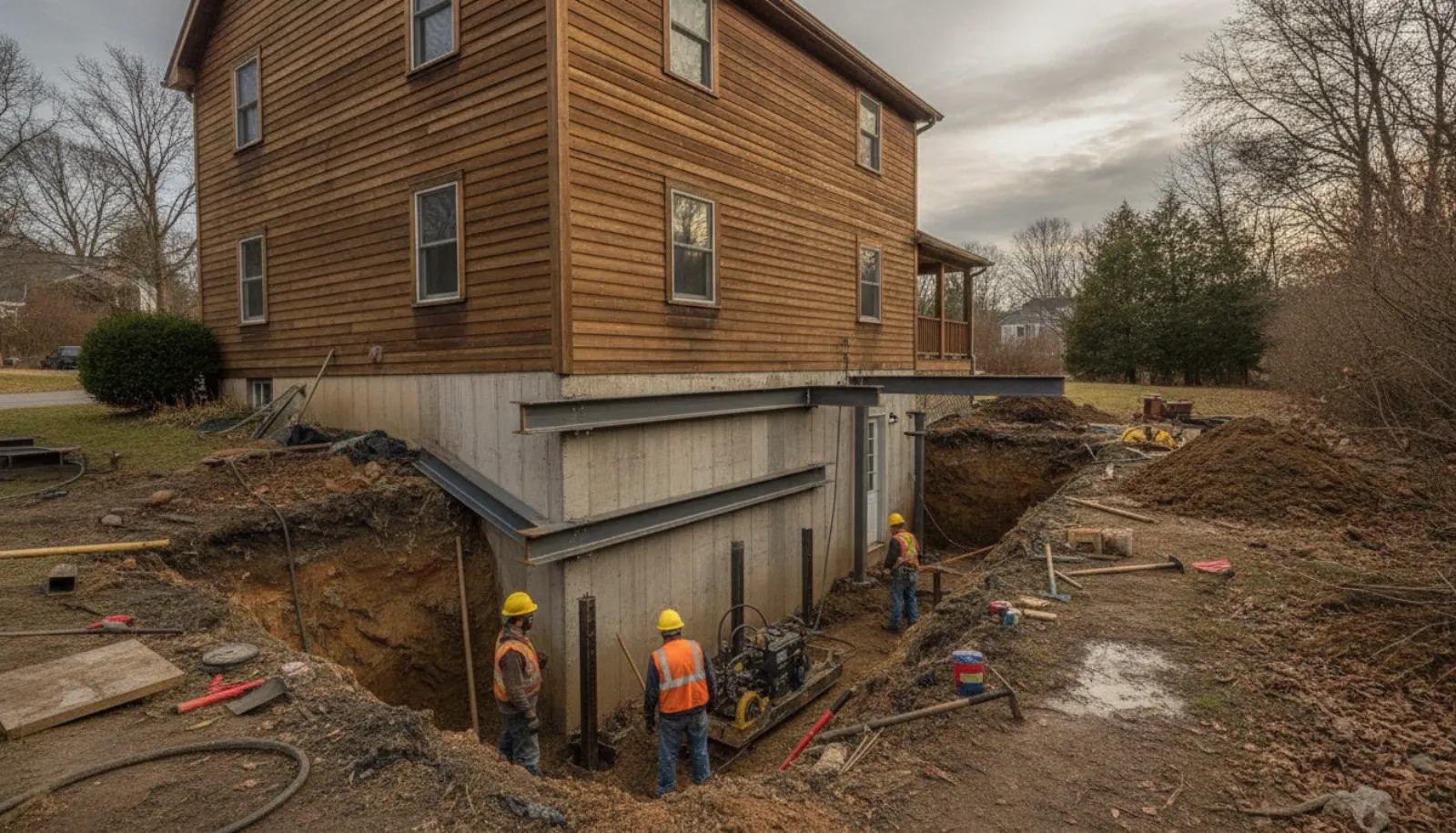
A settling wall. Sometimes the foundation wall or footing on one side has sunk. Then the floor slopes toward that wall, and you often see cracks in the foundation below it.
When it is minor and when it is urgent

Worth watching:

  • A slow, even slope that has not changed in years.
  • Small plaster cracks that stay the same.

Call soon:

  • A dip that is getting deeper.
  • A floor that feels soft or springy.
  • Posts that lean, rust through or sit on a cracked floor.
  • Wood that is soft when you push a screwdriver into it.
  • New cracks in the foundation wall under the low side.

Call right away:

  • A beam that has cracked or split.
  • A post that has moved or fallen.
  • A floor that drops suddenly.

How sloping floors usually get fixed

The inspector looks at the floor from below and finds what is carrying the weight.

New posts and footings

Steel posts on new concrete footings replace tired or temporary ones.

Sister joists

New lumber is fastened next to weak or cut joists.

Beam repair or replacement

A sagging center beam is reinforced or replaced, sometimes with steel.

Sill repair

Rotted sill boards are cut out and replaced.

Slow lifting

Jacks raise the floor a little at a time, then the new supports take the load.

Foundation repair

If a wall or footing sank, piers or wall repair fix that first.

Dry the basement

Fixing water and damp keeps the new wood from rotting.

Structural work like a new beam often needs a permit. The City of Rochester says structural repairs usually do. Ask your contractor to handle it.

What it typically costs

These are typical national ranges from published cost guides, not a quote. A few new posts cost far less than a new beam and lift. The cost guide has more.

What to do before the inspection

  1. Map the slope. Roll a ball in each room and note which way it goes.
  2. Look in the basement. Find the main beam and the posts under it. Take photos.
  3. Check the posts. Note any that lean, are rusty or sit on cracked concrete.
  4. Note the timeline. Write down when you first saw the slope and if it has changed.
  5. Clear a path. Move boxes away from the beam and posts so the crew can see them.

Frequently asked questions

Is it normal for an old house to have sloping floors?

A little slope is common in a 100-year-old house. Wood shrinks and settles over time. What matters is whether it is still moving. A floor that got worse in the last year or two, or a new bounce, is worth a look.

How much slope is too much?

There is no single cutoff for an old house. A ball that rolls slowly is often old settling. A dip you can see, a floor that feels soft, or cracks and sticking doors that are new are signs to call.

Can sloping floors be fixed without tearing up the floor?

Usually yes. Most fixes happen from the basement. New posts, a new beam or sistered joists can lift and hold the floor from below. Finished floors upstairs often stay in place.

Are the old metal jack posts in my basement OK?

Some are fine. Screw jacks that were meant to be temporary, posts that rust at the bottom, and posts without a solid footing under them are common problems. The inspector checks each one.

How fast can a floor be lifted?

Slowly. Old houses are lifted a little at a time so plaster and doors can adjust. Lifting too fast can crack walls upstairs.

Is it the foundation or the framing?

Look at where the slope goes. If the floor dips in the middle, it is often the center beam or posts. If it slopes toward one outside wall, the wall or footing on that side may have settled.

Floors sloping or sagging?

Call (585) 449-9661 or send the short form with a photo. A local crew will call back to set up a free inspection and a written price.

(585) 449-9661 Free inspection