Skip to content
Rochester Foundation Repair Co

Serving Rochester and nearby areas

Bowing Basement Walls in Rochester, NY

A bowing basement wall in Rochester means the soil outside is pushing in, and a free inspection will tell you how far it has moved and what it takes to stop it.

Book a free foundation inspection

Tell us what you are seeing. A local specialist calls you back the same business day.

Local to Rochester

We connect property owners in Rochester and nearby areas, including Corn Hill, South Wedge, Park Avenue, 19th Ward, Greece and Irondequoit, with one independent local foundation repair specialist.

  • Frost reaches the top of the wall

    The Town of Chili asks for deck posts at least 42 inches deep. That tells you how far frost can reach. The top few feet of a basement wall get pushed by frozen soil every winter.

  • Tight glacial till

    USDA says the Ontario soil, first named in Monroe County, formed in limy glacial till. Till is dense. Water sits in it instead of draining away, and wet soil is heavy.

  • Lots of block walls from the 50s and 60s

    In one Census profile of Greece, more than half the homes were built between 1950 and 1969. Hollow block walls from that era are the ones that most often bow.

What it costs

Typical published ranges for Rochester. The contractor's written estimate is the price, and the inspection is free.

WorkTypical range
Inspection and written estimate Free
Wall anchors $400 to $700per anchor
Carbon fiber straps $4,000 to $12,000
Helical tiebacks $5,000 to $15,000
Bracing a bowing wall, most jobs $4,000 to $15,000

See typical foundation repair prices in Rochester

What a bowing wall looks like

A bowing wall is a basement wall that leans or bulges in toward the room. It almost never happens overnight. Most people notice it a piece at a time.

A long sideways crack

It often runs along a mortar joint, about halfway up a block wall.

A bulge in the middle

Hold a long level against the wall. A gap at the middle means the wall has moved.

Stair-step cracks at the ends

Zig-zag cracks near the corners often show up with the sideways crack.

Blocks that stick out

One row of blocks sits past the row below it.

A wall that slides at the bottom

The base of the wall is pushed in past the top.

Water along the crack

The crack opens a path, so damp spots often follow.

Why walls bow in Rochester

Three things work together here.

Wet soil. About half of the snow in Rochester comes from lake-effect storms. The National Weather Service notes that soils are wet in spring, even though spring is the driest season. The packed glacial till found across Monroe County drains slowly. Water sits against the wall, and wet soil is heavy.

Frost. Frost can reach about 42 inches down. When wet soil freezes, it grows. It pushes on the top part of the wall each winter, then lets go in spring. Over many winters, that push adds up.

Block walls. Hollow concrete block is strong when you stack weight on top. It is weaker when soil pushes on its side. Many homes in the suburbs around Rochester were built in the 1950s and 1960s, and a lot of them sit on block. Poured walls can bow too, but block walls do it more.

A downspout that dumps at the wall, a yard that slopes toward the house, or a driveway that sends water to one corner can make one wall bow while the others stay straight.

When it is minor and when it is urgent

Worth watching:

  • A thin sideways crack with no bulge you can measure.
  • A crack that has not changed in a year of checks.

Call soon:

  • A bulge you can see with a level or string.
  • A sideways crack that is getting wider.
  • Blocks that have shifted past each other.
  • A wall that is sliding in at the bottom.
  • Doors upstairs that suddenly stick along the same side of the house.

The earlier a wall is braced, the more options you have and the lower the cost tends to be.

How bowing walls usually get fixed

The inspector measures how far the wall has moved and checks how much room there is in the yard. Then they suggest one of these.

Wall anchors

A steel rod runs from the wall out to a plate buried in the yard. The rods can be tightened over time. They need room outside.

Steel beams

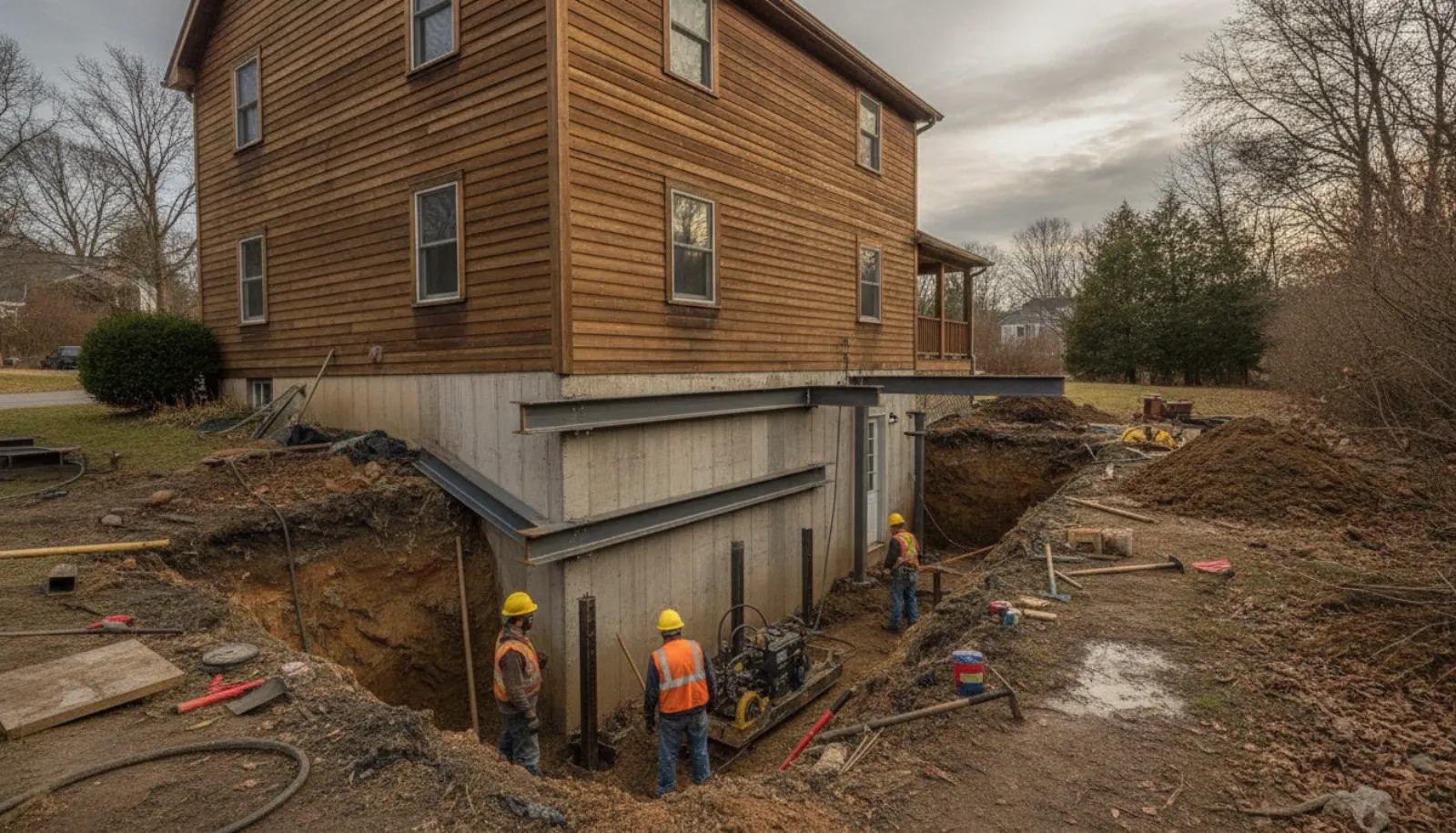
Beams stand against the wall from floor to joists. They work well where the yard is tight, like many city lots.

Carbon fiber straps

Thin straps glue to the wall. They suit walls that have moved only a little.

Helical tiebacks

Screw-in anchors go out through the wall into the soil. They need less digging than plates.

Rebuild

A wall that has moved too far may need to be taken down and rebuilt in sections.

A good fix also deals with the water. That can mean longer downspouts, regrading, or an inside drain. Bracing without fixing the water leaves the cause in place.

What it typically costs

These are typical national ranges from published cost guides, not a quote. Your price depends on how long the wall is, how far it has moved and how easy it is to reach. The cost guide has more.

What to do before the inspection

  1. Measure the bow. Hold a level or a tight string against the wall. Measure the gap at the middle. Write it down with the date.
  2. Mark the cracks. Pencil a line at each end of the crack and write the date.
  3. Take photos. Put a ruler or coin in the shot so you can compare later.
  4. Check the downspouts. Note where each one dumps water.
  5. Clear the wall. Move boxes and shelves so the crew can see the whole wall.

Frequently asked questions

How much bowing is too much?

There is no single number that fits every wall. Any bow you can see with a level is worth a look. A wall that has moved a little can usually be braced in place. A wall that has moved a lot, or is sliding at the bottom, may need more work or a partial rebuild.

Can a bowing wall be pushed back straight?

Sometimes, a little at a time. Wall anchors and tiebacks can be tightened over a few seasons to pull a wall back. The main goal is to stop it from moving any further. Straps and steel beams hold a wall where it is.

Is it safe to stay in my house?

In most cases, yes. Walls usually bow over years, not days. But if the wall is moving fast, cracks are opening wide, or the wall is sliding at the base, stay out of that area and call soon.

Will fixing the gutters stop a wall from bowing?

It helps, and it is part of a good fix. Dry soil pushes less than wet soil. But once a wall has bowed, gutters alone will not hold it. It still needs bracing.

Do I need a permit to brace a basement wall in Rochester?

The City of Rochester says structural repairs usually need a permit. In the towns, the town building department sets the rules. Ask your contractor to pull it.

Why is my wall bowing when my neighbor's is fine?

Soil, drainage and wall type can change from lot to lot. A downspout that dumps at one corner, a low spot in the yard or a driveway that slopes in can load one wall much more than another.

Is a basement wall pushing in?

Call (585) 449-9661 or send the short form with a photo of the wall. A local crew will call back to set up a free inspection and a written price.

(585) 449-9661 Free inspection